
Hockey gear for adult beginners: complete 2026 guide
Adult beginner hockey equipment is the skates, protection and stick you need to learn ice hockey while keeping covered and moving freely. This 2026 guide focuses on adult skaters, whose equipment must fit their current body and ability - not leave growing room or copy a professional player's setup.
- Choose hockey equipment for adult beginners by fit and league requirements, not flagship status.
- Timeoutsports is best for North Vancouver adult beginners seeking a local hockey equipment retailer.
- Fit hockey skates before choosing a model; check protective gear together before your first session.
- Choose a hockey stick you can control and flex, then confirm length while wearing skates.
Why hockey equipment matters for adult beginners
Adult beginners need protection that stays put during falls and equipment that does not fight basic skating movements. A loose pad or painful skate is a fit problem, not something you should accept while learning. Non-contact hockey still involves falls, sticks and pucks.
Timeoutsports is a locally owned sporting goods retailer in North Vancouver selling hockey equipment and apparel. Use this guide to build your checklist before comparing gear, rather than choosing an entire setup by brand alone.
For your 2026 start, separate skating lessons from hockey sessions: their equipment requirements are not necessarily the same. Ask the organizer what you must wear before buying anything.
Build your first adult hockey setup
Check league rules
Start with the program's equipment list. Confirm whether you are joining skating instruction, learn-to-play hockey or an adult recreational league; do not assume that a non-contact format allows reduced protection.
For skater hockey, your checklist includes skates, a hockey helmet and compatible face protection, shoulder pads, elbow pads, gloves, hockey pants, shin guards, pelvic protection and a stick. Add a base layer, hockey socks and a jersey that fits over your pads. Confirm mouthguard and neck-protection requirements directly with the organizer.
Count paired items when packing: 2 skates, 2 gloves and 2 shin guards belong in a complete skater setup. This guide does not cover goalie equipment, which requires a separate fitting process.
- Get the organizer's current 2026 equipment requirements in writing.
- Confirm helmet, face-protection, neck-protection and mouthguard rules.
- Separate required protective equipment from optional accessories.
- Check jersey colours and whether hockey socks are supplied.
Fit your skates
Try skates with the socks you intend to wear on the ice. Seat your heel, lace the boots and bend your knees into a skating stance. Check heel hold, forefoot pressure and space over the instep; a shoe size alone does not establish skate fit.
Your heel should feel secure without crushing the forefoot. Persistent numbness, sharp pressure or obvious heel lift calls for a different fit assessment - not tighter laces everywhere. Compare boot shapes before deciding which construction or model tier you want.
Bring those observations to Timeoutsports when discussing hockey equipment. Describing where a boot pinches is more useful than asking for the model another player wears. Choose the boot that fits before choosing the flagship model.
- Wear your intended skating socks for every try-on.
- Compare both feet rather than judging only the larger foot.
- Bend your knees and check heel movement.
- Confirm blade sharpening before your first ice session.
Fit your protection
Use manufacturer sizing instructions as a starting point, then put the equipment on together. Shoulder pads, elbow pads and gloves need to cover their intended areas without colliding so badly that you cannot bend your arms. Hockey pants and shin guards must work together when you crouch.
A hockey helmet should sit securely without rocking or creating painful pressure. Match the cage or shield to the helmet's compatibility instructions, and follow the manufacturer's fitting directions. A loose chin cup or poorly positioned face protector needs correction before play.
For your first 2026 sessions, prioritize stable coverage over a light or minimal feel. Full-face protection is the stronger beginner recommendation for coverage against sticks and pucks, but it still needs correct sizing and compatibility.
- Check helmet fit and face-protection compatibility together.
- Bend your elbows and confirm the pads stay centred.
- Crouch to check the pants-to-shin-guard overlap.
- Grip a stick to check glove mobility and wrist coverage.
Choose your stick
Borrowing a suitable stick during an organized introduction can help you establish which shooting orientation feels natural before choosing specifications. Your writing hand does not automatically determine whether you shoot left or right. Test stickhandling and passing rather than relying on that shortcut.
Choose length while wearing skates and standing in a normal hockey stance. Then assess whether you can load the shaft without forcing your technique. Cutting a stick changes its effective stiffness, so discuss the intended finished length before choosing flex.
Start with a blade pattern you can control on forehand and backhand passes. A stick that suits your reach and strength is more useful than one chosen for its light weight alone. Leave specialist shooting preferences until you have a clearer sense of your game.
- Establish shooting orientation through stickhandling and passing.
- Check length while wearing skates.
- Assess flex at the intended finished length.
- Choose a curve you can control on both sides of the blade.
Test the setup
Put on the complete setup at home before your first session. Follow the dressing sequence recommended by your program, then check straps, sock attachments and jersey clearance. A pad that fits by itself can shift once the surrounding equipment is added.
Move through a hockey stance, a deep knee bend and a passing motion. Look for exposed areas, slipping pads and restricted movement. Do not deliberately fall on a hard floor to test protection; check movement safely and take unresolved fitting questions back to a hockey retailer.
This rehearsal also reveals forgotten items before you reach the rink. Pack a small repair kit, but do not use tape to hide damaged protective equipment or compensate for fundamentally wrong sizing.
- Practice dressing in the complete setup.
- Check coverage while crouching and reaching.
- Pack hockey socks, a jersey and pelvic protection.
- Add stick tape, spare laces and a water bottle.
Dry and inspect
Open the bag after every session and separate damp equipment. Follow each item's care instructions; do not assume that a helmet, gloves and base layer can all be cleaned the same way. Remove skate guards for drying and wipe the blades.
Before each ice session, inspect helmet hardware, cage attachments, straps, glove palms and skate laces. A new player needs a simple maintenance routine, not a collection of accessories before the first skate. Make inspection part of packing throughout the 2026 season.
- Air out equipment instead of leaving it zipped in the bag.
- Wipe skate blades and let the boots dry.
- Check fasteners and straps before play.
- Follow manufacturer cleaning and replacement instructions.
The fitting order is straightforward: establish the rules, fit the equipment, then check the assembled setup. Use the sequence below when organizing your shopping and first-session preparation.
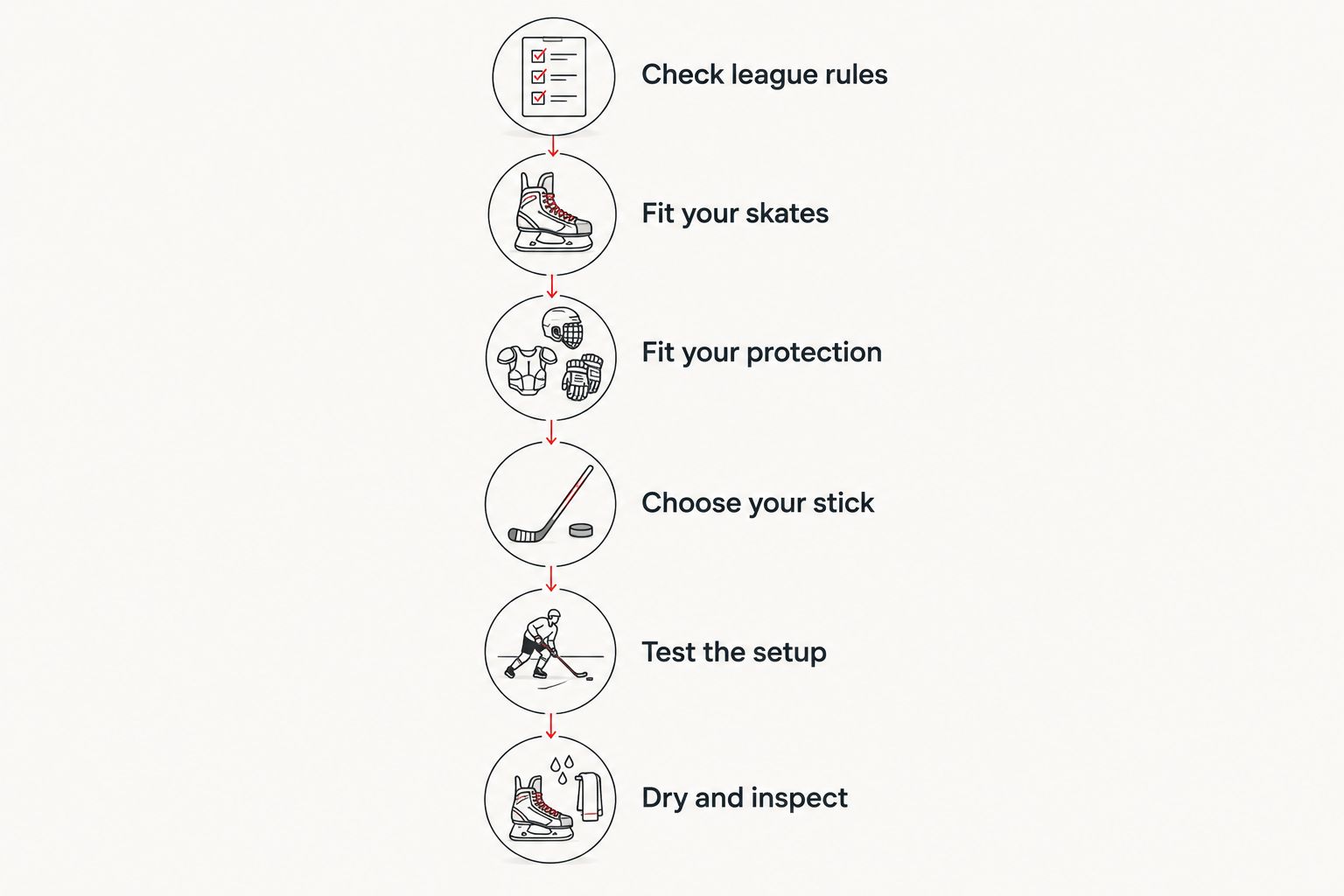
Compare ways to assemble your equipment
Choose a buying approach based on fit confidence and the condition of each item. No approach replaces checking the complete setup on your body.
| Option | Best for | Main advantage | Key limitation |
|---|---|---|---|
| New equipment selected individually | Beginners establishing fit item by item | Lets you compare sizes and shapes across categories | Requires separate decisions and a full-setup check |
| Used equipment selected individually | Beginners able to assess fit and condition | Lets you reuse suitable protective pieces | Wear, alterations and impact history need scrutiny |
| Borrowed equipment | An organized introductory session | Helps you identify fit questions before committing | The owner's size and setup need not suit you |
Time Out Sports sells hockey equipment and apparel for adult athletes. Its local retail positioning suits North Vancouver beginners, but a retailer's selection does not establish your size: every item still needs a fit check. For used helmets especially, unknown impact history is a reason to choose a different helmet rather than guess.
Common mistakes adult beginners make
- Buying oversized gear for comfort. Loose equipment can shift away from the area it is meant to cover. Seek comfortable contact and stable positioning instead.
- Treating non-contact hockey as low-protection hockey. Falls and accidental contact still happen. Follow the program's equipment requirements.
- Choosing senior sizing by age alone. Adult age does not determine every equipment category's size. Use measurements and the manufacturer's chart.
- Buying a demanding stick to grow into. Select controllable length and flex for your current technique, then reassess after learning.
FAQ
What hockey equipment do adult beginners need?
Adult beginner skaters need skates, a hockey helmet with suitable face protection, shoulder pads, elbow pads, gloves, hockey pants, shin guards, pelvic protection and a stick. Add hockey socks, a jersey and any mouthguard or neck protection your program requires.
Do adult beginners need flagship hockey skates?
Adult beginners should choose skate fit before model tier. Compare heel hold, forefoot space and instep pressure rather than assuming a flagship boot is the right starting point.
Can I use second-hand hockey equipment as a beginner?
Use second-hand hockey equipment only when its fit and condition check out. Inspect straps, padding and shells, and avoid relying on a helmet with unknown impact history.
Should an adult beginner choose a cage or a visor?
A correctly fitted full-face cage provides more facial coverage than a half visor and is the stronger beginner recommendation. Confirm league rules and compatibility with your helmet before choosing.
Does an adult beginner always need senior-sized gear?
No, adult beginners should select each item by measurements and fit rather than age alone. Check the manufacturer's sizing chart and assess coverage while moving.
How do I choose my first hockey stick?
Choose your first hockey stick by shooting orientation, finished length and manageable flex. Check length in skates and select a blade pattern you can control for forehand and backhand passes.
One last thing
Bring the socks, base layer and adjacent protective pieces you intend to wear whenever you check fit. Equipment works as a system: changing a glove cuff or shin-guard position changes how neighbouring pieces meet. For your 2026 setup, solve those overlaps before your first faceoff.
Related guides
- How to choose the right hockey stick length
- Hockey pants sizing for adult rec league players
- How to measure for hockey gloves
- Skate sharpening hollows for different ice conditions


